



Logitech MX Anywhere 3 Long-Term Review: The Ultimate Travel Mouse for Digital Nomads
Explore our deep-dive review of the Logitech MX Anywhere 3. From MagSpeed scrolling to glass tracking, find out how this mouse survives a year of global travel.
Logitech MX Anywhere 3 review, best travel mouse 2024, MagSpeed scroll wheel benefits, Darkfield glass tracking mouse, portable productivity mouse, Logitech Flow guide, mouse for small hands, USB-C rechargeable mouse, multi-device Bluetooth mouse, MX Anywhere 3 vs MX Master 3S, travel office setup, digital nomad gear, ergonomic travel mouse, logitech options plus software, silent click mouse comparison
One Year, Three Continents, and a Glass Desk: The Real Story of the Logitech MX Anywhere 3 Travel Mouse
If you pay close attention, you’ll notice a glaring disconnect in how people review travel mice. Most testers treat it like a lab experiment: they glide the mouse across a pristine home office desk for forty-eight hours, churn out a thousand technical words regarding DPI (Dots Per Inch) and click decibels, and then promptly move on to the next gadget. But that isn't travel. That’s a controlled environment. Real travel is messy, unpredictable, and physically demanding. It means yanking a mouse out of a laptop sleeve that has been crushed under an airplane seat for six hours. It means trying to be productive on a granite countertop in a dimly lit Airbnb where the Wi-Fi password is hand-scrawled on a fading sticky note. It means the frustration of a battery dying right as you settle into a three-hour layover in Frankfurt.
For the past twelve months, the Logitech MX Anywhere 3 has been the solitary occupant of my backpack’s tech pouch. It has weathered spilled lattes, survived a two-foot plummet onto hard tile, and endured the sheer indignity of being used on the scratchy fabric of a moving train seat—a surface no optical sensor should reasonably be expected to handle. This isn't a dry recitation of spec sheets. This is a field report on what actually matters when your office is the world and your desk changes every Tuesday.
Why the Travel Mouse Category Is Broken and How Logitech Fixed It
The fundamental problem with the travel mouse category is that most of these devices are designed by people who never leave their cubicles. You usually end up with two extremes: devices that are so tiny they turn your hand into a cramped, aching claw after thirty minutes of Microsoft Excel work, or "portable" mice that are just shrunken-down versions of desktop models stripped of everything that made them useful. The MX Anywhere 3, however, was born from a much smarter design philosophy. Logitech took the MX Master 3S—widely heralded as the gold standard for productivity—and asked a brutal question: What can we cut away without killing the soul of the experience?
As it turns out, the answer was surprisingly little. They sacrificed the thumb rest and the dedicated horizontal scroll wheel to save space, and they lowered the overall profile for portability. But they refused to compromise on the essentials. They kept the high-end electromagnetic scrolling mechanism. They kept the legendary Darkfield sensor that tracks on glass. They even kept the ability to toggle between three different devices instantly via Bluetooth Low Energy. This refusal to gut the core engineering, while only shedding the ergonomic luxuries, is exactly what elevates this mouse above every other "mobile" pointer on the market.
While competitors like the Microsoft Surface Mobile Mouse or the Razer Pro Click Mini often feel like a compromise you’re forced to endure, the MX Anywhere 3 feels like a deliberate choice. You don't bring it because you have to; you bring it because it makes chaotic working conditions bearable, and on rare occasions, even genuinely enjoyable.
The MagSpeed Scroll Wheel Is Not a Gimmick. It Is a Mental Health Tool.
Let’s talk about a very real, very modern ailment: scrolling fatigue. When your professional life requires you to spend ten hours a day digging through Adobe PDF files or endless legal documents, the act of scrolling becomes a repetitive stress injury in the making. Standard mechanical wheels force your finger into a "flick-and-stop" rhythm thousands of times an hour. These tiny micro-movements aren't just annoying; they add up to real physical strain, potentially contributing to carpal tunnel syndrome.
The MagSpeed wheel inside this mouse is a masterclass in over-engineering. By using electromagnets instead of physical notches, it offers a dual personality. In its "click-to-click" mode, you feel a tactile resistance that is actually a magnetic field pushing back. It’s softer, quieter, and far more precise than any mechanical ratcheting I’ve ever felt. Switch to "free-spin" mode, and the magnets let go entirely. The wheel suddenly has zero friction. Give it one solid flick, and it will spin for seven full seconds, allowing you to fly through a thousand rows of data with a single gesture.
But the real "aha!" moment isn't the wheel itself—it’s the "SmartShift" feature. The mouse actually senses how fast you’re trying to move. If you flick the wheel with intent, it automatically drops the magnetic resistance and enters free-spin. The second you touch the wheel to stop it, the magnets re-engage. It is so seamless that you stop thinking about how to scroll and simply start moving at the speed of your own thoughts.
The Glass Tracking Myth: What Logitech Does Not Tell You
Logitech’s marketing department loves to shout about how the Darkfield sensor works on glass. While this is technically true, the reality of the situation comes with some very important caveats. This sensor isn't a standard LED optical system; it’s a high-precision laser that tracks microscopic imperfections on a surface. Because glass is never perfectly smooth—it has dust, micro-scratches, and manufacturing pits—the mouse can usually find its way.

However, the thickness of that glass is the hidden variable. On a standard four-millimeter glass desk, the tracking is indistinguishable from a mouse pad. But if you find yourself at a massive twelve-millimeter conference table with a dark wood finish underneath, the sensor can get confused by the depth, resulting in frustrating cursor stutter. And if you happen to be working on mirrored glass, the reflective coating bounces the laser back in a way that renders the mouse completely useless.
In the real world, the performance is simultaneously better than you’d expect and slightly worse than the ads claim. I’ve used it on a glass coffee table in a Lisbon apartment without a hitch. I’ve used it on the glossy, slippery surface of a fashion magazine on a tray table. It worked perfectly. But the moment I tried to use it on a highly polished, deep-black granite kitchen island, the cursor began jumping around like a panicked insect.
The Ergonomics Debate: Small Hands Rejoice, Large Hands Suffer
No matter how good the sensor is, we have to address the elephant in the room: the size. This is a small mouse. If your hand measures more than eighteen centimeters from the base of your palm to the tip of your middle finger, you are going to have a complicated relationship with this device. It is not a "palm grip" mouse for large-handed users; your palm will inevitably hover in the air, forcing you into a claw grip that can be tiring during marathon sessions.
However, for those with small to medium hands, the ergonomics are surprisingly clever. With a length of roughly ten centimeters and a width of six, it creates a shape that nests comfortably within a cupped hand. Interestingly, after a year of use, I found my hand naturally adapted. The lower profile actually encouraged a healthier wrist posture for me, as my hand sits slightly elevated rather than being forced flat against the desk, which helped alleviate pressure on the median nerve.
The Missing Storage Slot: A Design Sin Worth Discussing
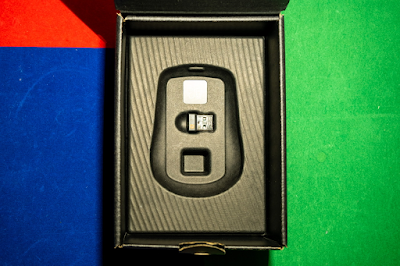
I need to be blunt here: the decision to omit a storage slot for the Logitech Bolt receiver is an inexplicable failure of design. This receiver is barely the size of a fingernail clipping. There is no hidden compartment under the battery door and no magnetic clip on the bottom to keep it secure.
This isn't just a minor gripe. While Bluetooth has come a long way on macOS and Windows 11, it is still prone to interference in crowded environments like tech conferences or busy airport terminals. The USB receiver provides a rock-solid 2.4GHz connection that cuts through that noise. By failing to provide a place to store it, Logitech has made it almost a statistical certainty that you will eventually lose your best connection option.
Battery Life and the Charging Paradox
Inside the chassis is a 500mAh lithium-polymer battery. Logitech’s marketing claims seventy days of battery life on a single charge. In my experience, if you’re actually working eight-hour days, that number is closer to three or four weeks. While that’s shorter than advertised, it’s still more than enough to survive a long international trip without ever needing to unpack a charging cable.
When you do need power, it uses USB-C, which has thankfully become the universal standard. A quick one-minute "emergency" charge gives you about three hours of life. Most importantly, unlike the Apple Magic Mouse—where the charging port is famously on the bottom, rendering it useless while charging—Logitech put the port on the front edge. This allows the device to function as a wired mouse in a pinch, ensuring you're never actually stranded.
Logitech Flow: The Feature You Did Not Know You Needed
If your workflow involves juggling two machines—perhaps a MacBook Pro for your creative heavy lifting and a corporate ThinkPad for spreadsheets—Logitech Flow will change your life. It allows your cursor to move off the edge of one screen and onto the next, as if the two laptops were simply two monitors connected to the same computer.
The real "magic" trick, however, is the cross-platform copy-and-paste. You can copy a string of text on your Windows machine, slide the mouse over to an iPad, and paste it instantly. As long as you have the Logi Options+ software installed on both systems, it works with uncanny reliability. It’s one of those features that sounds like a gimmick until the third time it saves you from having to email a file to yourself.

Final Thoughts After Three Hundred Days of Travel
The Logitech MX Anywhere 3 is far from a perfect piece of hardware. The lack of a receiver slot is a genuine oversight, and the middle-click button is a bit too stiff for my liking. But when you evaluate it within the context of its true purpose—professional-grade productivity in transit—it stands in a league of its own.
If you already use an MX Master at home, this is its natural, globetrotting companion. If you are someone who builds their "office" in coffee shops and coworking spaces, this is likely the only mouse you will ever need to buy. Buy it for the unparalleled scroll wheel, keep it for its ability to track on a glass coffee table, and if you often find yourself working in hushed libraries, look at the newer MX Anywhere 3S for its silent-click switches. Your fellow travelers will thank you for the silence.
Suggested FAQs
Q: Does the Logitech MX Anywhere 3 work on glass surfaces? A: Yes, it uses a Darkfield High Precision sensor designed to track on glass at least 4mm thick by detecting microscopic imperfections on the surface.
Q: How long does the battery last on a full charge? A: While Logitech claims up to 70 days, heavy professional use (8 hours/day) typically results in about 3 to 4 weeks of battery life. A one-minute quick charge provides 3 hours of use.
Q: Can I use the MX Anywhere 3 with multiple computers? A: Yes, it can pair with up to three devices via Bluetooth or the USB receiver, and it supports Logitech Flow for seamless cursor movement and file sharing between systems.
Q: What is the difference between the MX Anywhere 3 and the 3S? A: The newer 3S model features 'Quiet Click' buttons which are significantly more muffled than the mechanical clicks of the original 3, along with an upgraded 8,000 DPI sensor.