

The Top 7 Reverse Image Search Tools for 2026
The internet has billions of pictures. If you wish to use some of them for your business or personal projects, how can you confirm their provenance?
Google searches sometimes turn up images that have been altered, stolen, or copied. Could you separately attempt to find out where it came from or confirm that it's an original image? Or does that need to be done by an expert?
You will undoubtedly require expert assistance if you are discussing high-profile legal copyright concerns and other tasks. However, you may just utilize a reverse image search engine for daily usage.
Note: Reverse image searches are often not used by the services to save your data. However, you might want to review their privacy rules before moving further if you are searching for something sensitive.
Tiny Eye
One of the best additions to Chrome for speedy searches is TinEye.
To obtain further information using TinEye, you will need to upload the image or paste the image URL. They provide enterprise/corporate options to automate picture tracking and notify you if your image is used without permission, even if it is initially free to use.

TinEye concentrates on several facets of picture recognition and computer vision, in contrast to a typical image search tool. In order to locate an image's original source or authenticate it while doing the search, you have the option to combine its other goods.
Lenso.ai
An excellent illustration of an AI image search tool that makes it simple to locate the pictures that most appeal to you is Lenso.ai. Lenso.ai's sophisticated AI technology makes it simple for you to begin looking for the following things.
Locales: look for comparable buildings, landscapes, and locales in the picture.
People*: Use Lenso's face search to trace your digital footprint and use facial recognition to find similar faces.
Duplicates: Look for copies of the picture you uploaded as well as versions that have been changed, cropped, or filtered; see the original version of an altered or edited image.
Similar: Look for photographs and images that are comparable to the submitted image, but not necessarily duplicates; identify images with a similar layout or content.
Related: Look for pictures that are connected to the submitted image in some manner, even if they aren't exactly the same.
*Available in a few areas
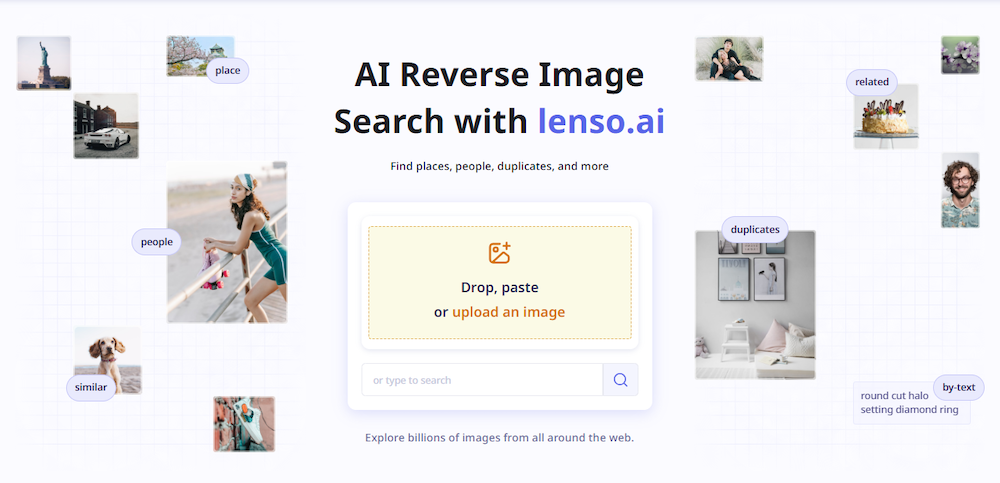
Reverse image search is now quicker, simpler, and more precise thanks to Lenso's AI-powered technology.
Pixsy
Pixsy is an intriguing reverse search picture tool that you may access for free by registering.
It should be useful because it allows you to import pictures from a variety of sources, such as social media sites and cloud storage services. To conduct a search, you may also upload images straight from your computer.
Like TinEye, Pixsy provides enterprise/business plans that allow you to automate tracking and obtain legal assistance for copyright violations.
Google Pictures

The best desktop reverse image search engine is Google Reverse Image Search. They need to list billions of images from millions of web pages.
Therefore, Google reverse image search ought to be your greatest option if you are unable to get a match for your image utilizing other methods. You may upload the image or paste the image URL, and you do not need to register in order to use the service.
In contrast to some other search engines, you will receive a large number of suggestions that are similar to the image you submitted, even if there are no precise matches.
Please be aware that using a mobile browser will not allow you to upload or paste picture URLs. You must request the desktop site from your browser's menu in order to obtain the capability. Google may think about making the website mobile-friendly.
You may use Google Lens in addition to Google Images to locate comparable photos online. Google Lens is accessible via Chrome on desktop and the Google App for iOS and Android.
Visual Search on Bing

Google Images and Bing's Visual Search are comparable. Additionally, it has a "text mode" that allows you to identify any reverse image search results by choosing any word in the picture you submitted.
Of course, you can also try text-to-image conversion, but this could be more practical.
The text mode offers additional benefits, such as the ability to locate landmarks, items, and more rapidly. Thus, it's worth a shot!
Image Search on Yahoo

Uploading pictures is not supported by Yahoo Image Search. Therefore, it is not the best tool for searching for reverse images. Nonetheless, you may use the original image's file name or metadata to search the database for a match.
Yahoo still scrapes up a sizable portion of online sites along with the data for different photos, despite the fact that it is no longer a major player on the internet. Thus, it's worth a try.
Reverse Image

Reverse Image helps you quickly identify an image source from top search engines, including Google, Bing, Yandex, and Baidu.
One can input the subject images via image search, upload locally, import from Dropbox or Google Drive, input a URL, or use a camera to capture.
Reverse Image supports files in JPG, JPEG, PNG, or GIF format.
The forever-free subscription is ad-supported and offers a limited number of image searches per day. The premium plan is ad-free and has features like advanced image search, unlimited tool usage, custom filters, search history, and more.
What Is Reverse Image Search?
Reverse image search is a technique to search for the source (or other sources) where a particular image originated.
If you are curious about an image on your device, you can easily use some of the tools available for reverse image search and dig for more information about it.
Some of the use cases where you can utilize reverse image search tools:
To check if someone is using your copyrighted work without permission
To identify a person or get the contact details on the web
To check the authenticity of a picture
To find out the source of the image
To identify fake news
You can perform a reverse image search on your iPhone or Android smartphone. All you need to do is access a web browser (desktop or mobile) and upload the image.
Reverse image search tools have some excellent benefits.
You can verify the authenticity of an image for free.
Save time from manual verification of an image on your device or someone’s social media profile.
Find royalty-free images that you can use for your work.
Locate a place or settlement from a long-forgotten photo in your loft.
Find out information about unknown objects or unlabeled products.
All these, and you do not even have to spend a penny for it. I think one of the most valuable benefits of a reverse image search tool is to be able to identify if someone else is using your picture or artwork.
Image theft is common and is often impossible to prevent. Hence, a tool to find out about an image is helpful for such work.
Wrapping up 😎
There are plenty of reverse image search tools available. Some are geared towards enterprises, and some offer a massive collection of images without signing up.
The options listed in this article have the same purpose but with varying effectiveness and use cases. Do explore and choose the best tool as per your requirements.